August Epp
Women TalkingAugust Epp returns to the Molotschna Colony as a schoolteacher with a precarious place in its community and a past shaped by exile. When Ona Friesen asks him to record the women’s meetings, he becomes more than their minute-taker: he translates their speech into a written record they cannot themselves read, while confronting the distance between preserving their words and speaking from his own position. His growing closeness with Ona and his eventual discovery that Peters is his biological father make his return both a practical role in the women’s deliberations and a reckoning with the colony’s history of exclusion.
Identity and Return
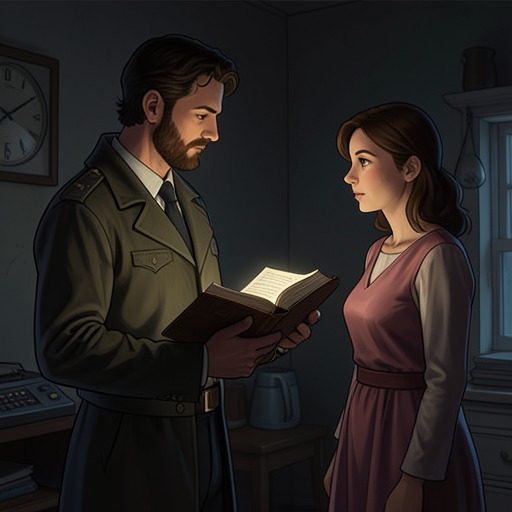
August identifies himself as a schoolteacher and the appointed recorder of the meetings. The women are illiterate, so he considers his name and the date appropriate at the top of the document, much as he would expect his students to identify their work. Yet his appointment begins with Ona’s request to record the discussions and create a document about them, not with the women assigning him a conventional secretarial role. He is an intermediary whose literacy makes the record possible, but whose presence also shapes what will survive on the page.
His return is recent and provisional. Seven months after coming back to the colony, he is lodged alone in a shed under an arrangement Peters calls temporary. August notes that he does not mind the accommodation, but the uncertainty of his status is telling: his return has not restored an uncomplicated home. He had been expelled from the colony with his parents, and as an adult he has to seek acceptance again. The colony’s ordinary family houses are not where he lives; his place is a separate dwelling large enough for him and a horse.
Before returning, August had studied in England, where his parents had gone after their excommunication. During university he experienced a nervous breakdown and became involved in political activity that led to his expulsion and imprisonment. His mother died while he was in prison, and the man who had raised him had disappeared years earlier. After completing a teaching degree through correspondence while incarcerated, August found himself homeless and in severe distress. A librarian listened as he recalled his childhood with Ona and urged him to return to the place where life had once made sense to him, even if only through childhood play. He followed that advice and sought readmission, work teaching English to the boys, and renewed friendship with Ona.
Recorder, Translator, and Keeper of the Minutes
The record August makes is mediated from its beginning. The women speak Plautdietsch, their language, which he renders mentally into English before writing it down. He explains that the language is unwritten and little known beyond the Mennonite community; translation is therefore not a mechanical transcription but a necessary step between the women’s speech and the document. His notes also include explanations and context that the speakers themselves do not supply in the same form. The resulting minutes preserve their debate while bearing the marks of the literate man who translates and frames it.
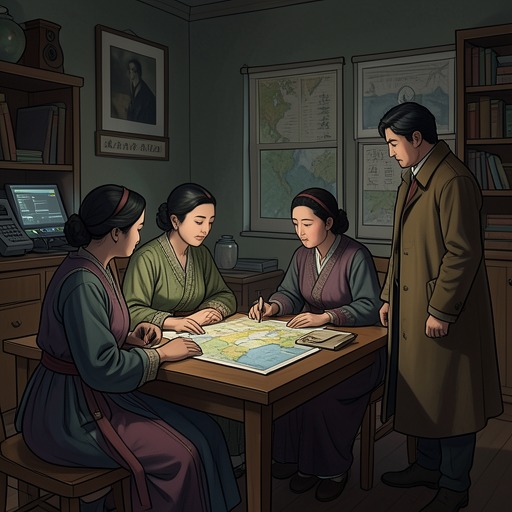
The women meet in a barn hayloft, away from crowded kitchens, and August waits there to do what Ona asked. When she gives him brown paper used for packaging cheese and meat, she suggests that he make large lists of the advantages and disadvantages of their options. The women will not be able to read what he writes, she acknowledges, but the lists can remain in the loft as an artifact for others to discover. This proposal makes the contradiction central to his work: the written record is inaccessible to its immediate speakers, yet its material survival may allow future readers to encounter their deliberation.
August’s role is not simply to take dictation. He responds to the women’s questions, records their disagreements, and offers judgments that influence discussion. Later, when he is preparing to leave, he runs back to retrieve his notebooks and the minutes so that they can be given to Ona. Salome points out that Ona cannot read them. The gesture does not resolve the problem of access, but it shows that August understands the record as belonging to the women and to a future beyond the meeting, rather than as merely his own account.
Ona Friesen and the Past of the Colony
August’s bond with Ona predates his return. As children they played together, marked the changing seasons by small shifts in daylight, imagined themselves as misunderstood disciples, and jousted on horseback with fence posts. They also kissed and quarrelled. In remembering these scenes to the librarian, August describes not just a childhood attachment but the imaginative world that gave him a reason to think of Molotschna as a place he might return to. The woman who asks him to keep the minutes is thus also the person through whom he reconstructs a lost sense of home.
Their present relationship grows through the meetings and their conversations beyond them. August’s affection for Ona is a source of renewed courage, and his hopes for her inform the future he imagines after the women leave. When he speaks about teaching the boys, he pictures Ona as his enduring point of orientation and imagines children in Mennonite schoolhouses asking to hear her story. This is an imagined future, not an outcome the narrative confirms, but it shows how he converts private attachment into a broader hope that the next generation might learn differently.
Ona’s circumstances are also part of August’s understanding of the crisis. She is pregnant following the assaults that have brought the women together, and the colony’s elders have judged her through the stigma attached to her condition and her Narfa. August records her questioning what the women are supposed to forgive if they were unconscious during the attacks and have been denied counselling afterward. Her questions expose the gap between the authorities’ language of forgiveness and the women’s ability to understand and name what has happened to them. August’s record gives those questions a place in the discussion, even as the women’s restricted literacy means they cannot directly inspect his written version.
The Women’s Deliberations and August’s Response
The meetings take place in the wake of years of assaults on women and girls, which the colony had attributed to supernatural causes before the perpetrators were identified as men from Molotschna. August recognizes one of the accused from childhood; he remembers the boy as a playmate who knew, or claimed to know, the names of the planets. The recognition joins the crisis to August’s own past: the violence is not an outside threat alone but a betrayal within a community whose children once played together.
When the women consider whether boys aged thirteen and fourteen should be allowed to leave with them, August answers that they may pose a danger, as any person can, but that they are still children capable of learning. He describes their impulsiveness and physical energy without treating those traits as a fixed destiny. His answer rests on a belief that careful direction, affection, patience, and education can help them learn different roles as men. Ona silently follows his recollection of principles his mother had taught him, linking his educational faith to Monica Epp and to a tradition of teaching that the colony had once suppressed.
That hope coexists with his practical participation in the plan. August tells the women he has obtained the Co-op Safe, dynamite, and a world map, and adds a sextant whose usefulness he questions. The objects show him moving beyond the record-keeping desk into material assistance for the women’s departure. His contributions do not make him the author of their decision; the women debate and decide among themselves. Instead, his role combines documentation, counsel, and concrete aid while leaving their collective deliberation at the center.
Exile, Paternity, and the Meaning of Home
At the close of the narrative, August’s history of expulsion is revised by a revelation about his parentage. He learns that he was not sent away because his parents had shown colonists art images or because Monica had secretly taught girls in the barn. The colony’s reason for expelling the family was that, by the time August was twelve, he closely resembled Peters, his biological father, and had become a living reminder of shame, violence, and an unacknowledged sin. Peters is not the father who raised and then abandoned him, but the younger bishop whose authority is entangled with the community that rejected August.
The revelation changes the meaning of his return. August had understood himself as the child of parents punished for forbidden knowledge and education; he now sees that his own existence also stood at the center of the colony’s concealed history. His mother’s secret school and the family’s images remain part of the story, but they were not the whole explanation for exile. The personal discovery sharpens the novel’s wider question about where evil and knowledge are located: in the outside world the colony fears, or within the community that controls what can be spoken and known.
August’s final imagined work is to teach the boys about Ona. He pictures her becoming a story passed among Mennonite schoolchildren, a figure associated with facts, laughter, and a life that the colony’s inherited judgments could not contain. The image does not erase his dependence on written language or the fact that the women cannot read his minutes. Instead, it gives his two roles—the recorder of a decision and the teacher imagining what may follow—a shared purpose. He returns to Molotschna to recover a place in it, but the record and the future he imagines point toward a community that might belong to those it once silenced.